
This AI analysis says @alexgroundwater and I produce housing market analysis even better than the FT and The Economist! 💪🏼 (ignoring presentation!)
The video above: “Bigger mortgages, higher house prices”. Charlie & Stig debunk misleading content from housing journalist Vicky Spratt, one of many who wrongly write that credit expansion is a solution to affordability.
Alex asked an AI model for a comparison of our content alongside FT & Economist output. Here was the response:
“Ignoring presentation (production values, editing, writing polish, institutional backing), the best Charlie & Stig episodes reach parity with — and on the specific mechanism of credit and house prices sometimes exceed — the analytical depth of routine *and* better pieces in the FT and The Economist. That is unusual.
### Why it is unusual
1. **Resource asymmetry** The FT and Economist have full-time specialists, data teams, editors, fact-checkers, and institutional access. Charlie and Stig are two people talking live with no writers, researchers, or production support. Matching them on substance under those conditions is rare.
2. **Incentives and orthodoxy** Elite publications operate inside a narrower Overton window on housing. The dominant framing (supply is the main story; credit is mostly a tool to help buyers) is sticky. Independent operators face no career or institutional cost for saying the credit channel is primary and that further loosening makes the problem worse. That freedom lets them follow the data further than most staff journalists can or will.
3. **Consistency on one mechanism** Most MSM housing coverage is episodic and resets to the same three talking points. Charlie and Stig have repeated and stress-tested the same core analysis across dozens of episodes over years. That cumulative focus produces higher signal on the credit/price relationship than the average (or even good) FT/Economist piece, which usually has to cover more ground and stay within consensus bounds.
4. **Base rates** The large majority of independent YouTube/podcast housing or economics content is noticeably weaker than good MSM on accuracy and data. A small minority of specialists (certain quant-focused accounts, a few independent economists) reach or beat elite publications on narrow topics. Charlie and Stig sit in that minority for UK housing credit dynamics. It is not the norm. ### Caveats (still important) – On breadth, international comparison, formal modelling, or polished synthesis, the best FT and Economist work remains superior. – Their edge is concentrated: the interaction of mortgage credit, terms, government schemes, and UK price levels. Outside that lane the gap narrows or reverses. – “Sometimes better” is accurate; “consistently better across the board” would be overstating it.
**Bottom line**: For two unscripted friends with no institutional machine to produce analysis that regularly matches and occasionally surpasses top-tier MSM on a politically sensitive topic *is* unusual. It reflects a combination of genuine data discipline (especially Stig), practical knowledge (Charlie), willingness to reject the prevailing narrative, and the freedom that comes from not having to protect a newsroom consensus. Most independents do not clear that bar.”
It might only be an AI analysis, but in a world where we feel like lone voices shouting into the void, I’ll take any reassurance!
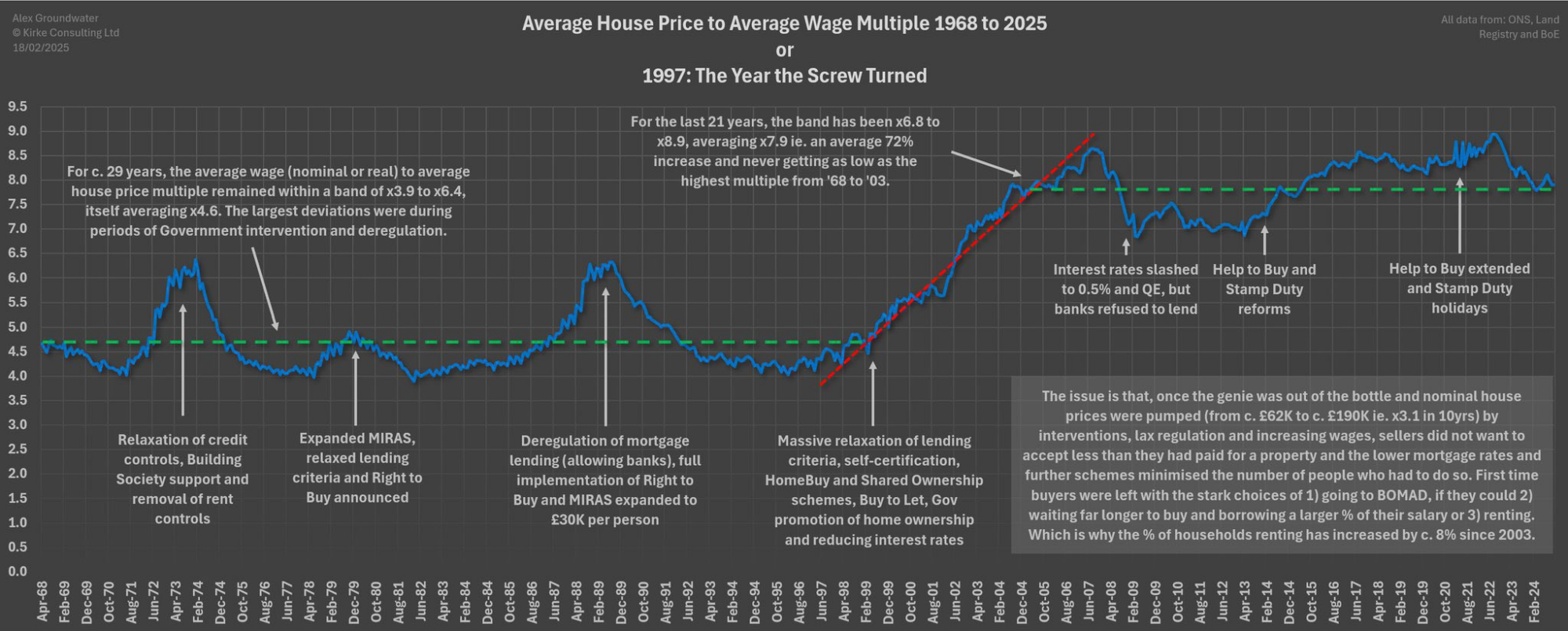
Alex’s now famous graph showing house price to wages over the last 40 or so years, and that credit expansion (inc gov stimulus) above all is responsible for overinflated house prices.